
Table of Contents
Hardwired Alarm System Essentials
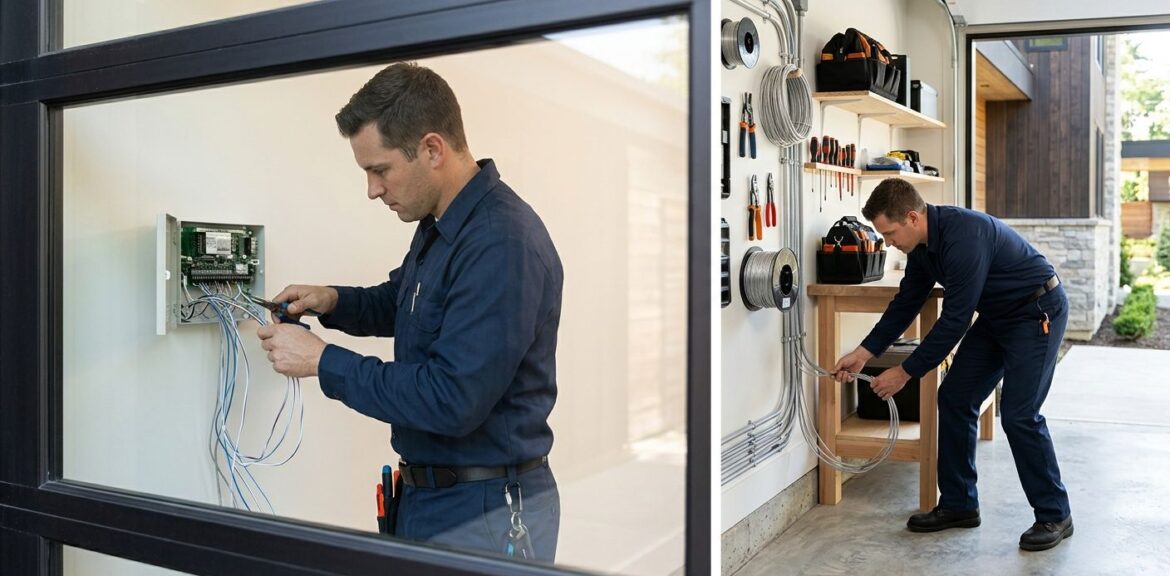
In commercial settings, each hardwired alarm system builds its function on physical conductors rather than radio frequencies. According to SecuritySystemsAuthority, wired systems utilize dedicated copper transmission mediums such as 22-gauge twisted pair or Cat5e/Cat6 cabling to create tamper-resistant circuits between sensors, panels, and communicators. This metal-to-metal architecture eliminates the spectrum constraints and signal-failure annunciation windows that wireless technology must manage under NFPA 72 guidelines, making hardwired installations the compliance baseline for new commercial construction.
We see this standard reaffirmed across the facilities we serve: a typical 100,000-square-foot commercial building incorporates between 30 and 60 miles of low-voltage cable to support security, access, and video subsystems that must operate without interruption. Over a 10-to-20-year lifecycle, the cost efficiency and signal integrity of a wired backbone consistently outperform wireless alternatives in structures where walls are open during initial build-out. Code authorities, insurers, and fire marshals expect that permanence, which is why architects and electrical engineers specify hardwired pathways in the construction documents from day one.
This reliability-driven standard makes a hardwired backbone the ideal foundation for our Prima All-in-One hardwired panel, which transitions that physical-layer dependability into an intelligent, app-managed platform for daily operations.
Prima All-in-One Hardwired Panel
Overview
A hardwired system is only as strong as its central controller, and the Prima All-in-One Hardwired Panel delivers the reliability and expandability that a permanent security setup demands.
Features
The Prima panel packs these standout capabilities:
- Touchscreen interface for intuitive local control.
- smart self-healing Wi-Fi maintains robust connectivity.
- Multiple wired zone inputs accommodate numerous sensors.
- Napco compatibility ensures seamless integration with proven components.
- Alula App integration enables remote management and alerts.
- Built-in siren driver provides audible alarm activation.
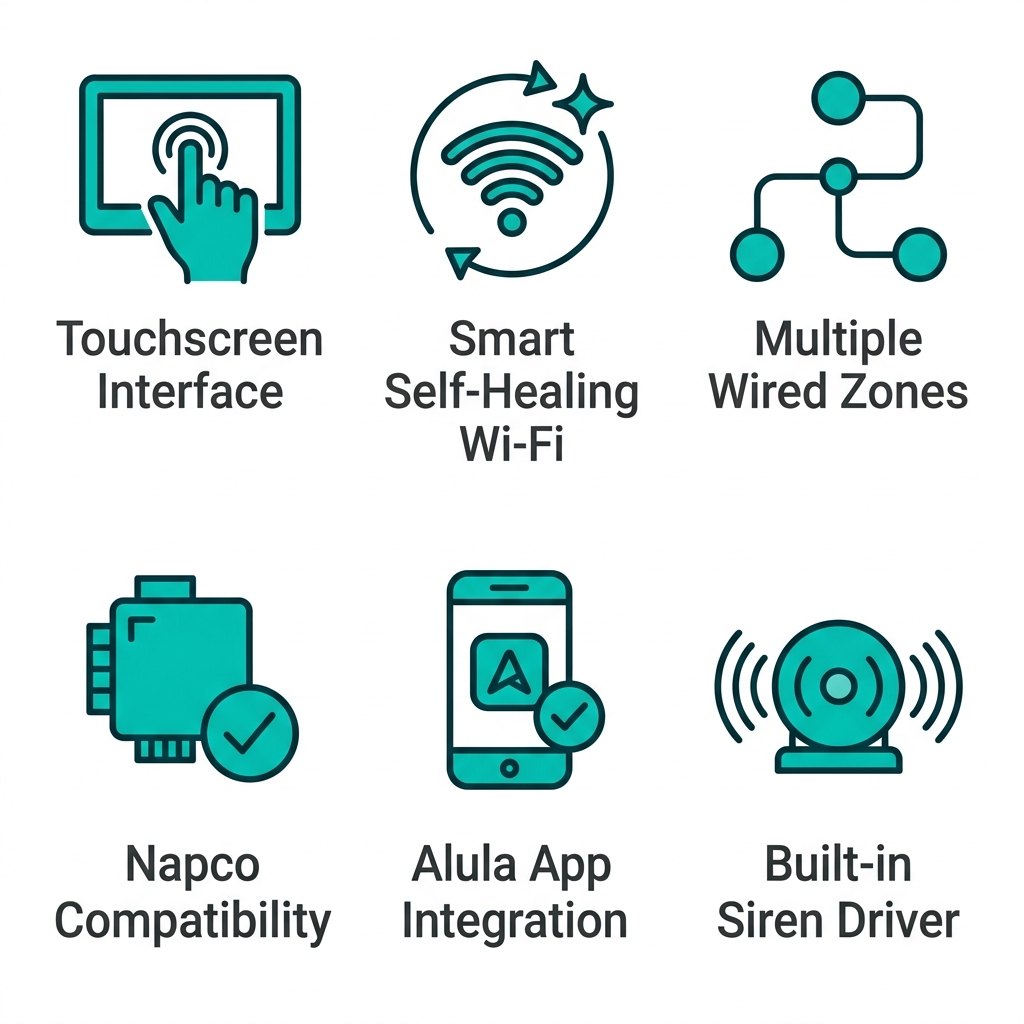
Icon set of Prima All-in-One panel features: touchscreen, Wi-Fi, wired zones, compatibility, app integration, siren.
Pricing
The hardwired alarm system cost depends on these variables; contact us for a personalized quote.
Pros and Cons
Industry analysis from Home Safety Authority points out that hardwired panels eliminate battery management and are ideal for permanent installations.
Pros
- Rock-solid wired reliability eliminates signal interruptions.
- No sensor batteries to replace, reducing long-term maintenance.
- Hybrid architecture supports wireless devices alongside wired sensors.
Cons
- Requires professional wiring during initial installation.
- Less portable than all-wireless systems.
Best For
The Prima All-in-One Hardwired Panel is the ideal choice for:
- New construction projects where cabling is straightforward.
- Whole-home security builds that demand uncompromised reliability.
- Homeowners who want a permanent core with the option to add wireless peripherals.
With the panel in place, adding hardwired motion sensors extends detection to every corner of the property, creating a complete, professionally wired security layer.
Hardwired Motion Sensors
Building on the reliability of the Prima All-in-One Hardwired Panel, our hardwired motion sensors offer steadfast intrusion detection without the need to manage batteries or worry about wireless signal interference.
Overview
Our pet-friendly wired motion detectors are designed to distinguish between an intruder and a family pet, eliminating false alarms while providing unwavering coverage. They connect via low-voltage wiring to the Prima panel, ensuring immediate signal transmission and constant supervision.
Features
Each hardwired motion sensor uses dual technology, combining passive infrared (PIR) and microwave detection, to validate movement before triggering an alarm. Our sensors feature pet immunity up to 40 pounds, adjustable sensitivity for different room layouts, and wide-angle lenses that capture motion across expansive areas. The low-voltage wiring connects directly to the Prima panel, enabling supervised circuit integrity that detects tampering and maintains constant communication. Because the system reads resistance changes, it instantly recognizes any attempt to cut or short the circuit.
Pros and Cons
The foremost advantage is no battery changes — these sensors draw power from the panel’s low-voltage circuit, providing a lifetime of service. Wired sensors also offer high reliability and are immune to wireless jamming since they operate on a supervised physical loop. According to the National Home Safety Authority, wired circuits with end-of-line resistors detect both open and short tampering, improving overall tamper resistance. The trade-off is that installation requires professional wiring, which can complicate repositioning if you rearrange a room.
Best For
They are a strong choice for new construction or major renovation projects where wiring access is straightforward and long-term reliability is a priority.
Hardwired Door/Window Contact Sensors
Overview
In a hardwired alarm system, door/window contact sensors serve as the first line of defense, much like hardwired motion sensors that also connect to the panel via low-voltage wiring. A magnetic reed switch detects the opening of a door or window and triggers an alert. This battery-free design provides reliable, low-maintenance perimeter detection, and flush-mounted units can be painted to blend with surrounding trim for a clean finish.
Features
We offer flush-mount and surface-mount configurations to match any installation. Long-life reed switches ensure lasting durability, while programmable zones can be set for instant alarm or entry delay. Tamper-proof wiring prevents bypass attempts, and all low-voltage conductors meet Class 2 separation requirements under IRC 2024.
Pricing
Our hardwired contact sensors are cost-effective and are included in our standard hardwired system packages. Every customer receives a transparent cost breakdown during the design consultation, so there are no hidden charges.
Pros and Cons
Pros: Flush-mounted sensors can be painted to match trim, making them virtually invisible. Battery-free design eliminates periodic replacement. Hardwired circuits resist interference and jamming. Cons: Retrofitting into existing walls demands drilling and wire fishing, which can be invasive. Historic or delicate window frames may not accommodate sensor mounts. Wiring must be kept separate from line voltage per code, adding routing complexity.
Best For
These sensors are ideal for new construction and full-window replacement projects in Southern California, where wiring can be concealed before finishing. They also suit commercial spaces that need a discreet, tamper-resistant perimeter.
Smart glass break detectors also rely on low-voltage concealed wiring and adhere to the same IRC 2024 compliance requirements.
Hardwired Glass Break Detectors
Overview
Door and window contact sensors secure entry points, while glass break detectors protect windows that can be broken without opening. Hardwired models listen for the acoustic signature of breaking glass and tie directly to the alarm panel. We install these in Southern California properties to reinforce perimeter security.
Features
Dual-frequency analysis distinguishes genuine glass breaks from everyday noises such as barking dogs or traffic rumble. An adjustable sensitivity setting lets our technicians tune each unit to the room’s acoustics, significantly reducing false alarms. With a 25-foot detection range, a single detector can cover multiple windows in a typical space. Low-voltage wiring connects directly to the panel, eliminating battery changes and ensuring reliable power.
Pricing
Pricing is transparent per-detector, with volume discounts when protecting multiple windows or storefronts. Contact our team for a detailed quote based on your property’s layout.
Pros and Cons
Pros: No batteries to replace, reliable detection through curtains or blinds, and immunity to wireless interference. The hardwired connection ensures instant alarm panel notification. Cons: Careful placement is essential; detectors must be located where the sound of breaking glass travels clearly. Laminated or safety glass may not produce a recognizable frequency, so they are not a standalone solution for every window. Our evaluation helps identify effective coverage for your building.
Best For
These detectors excel in rooms with numerous ground-floor windows, glass entry doors, or commercial storefronts throughout Southern California. They integrate well in quiet interiors, supporting the robust perimeter security of hardwired systems, complementing door and window contact sensors.
Hardwired Smoke & CO Detectors
Overview
Just as hardwired glass break sensors protect against forced entry, hardwired smoke and CO detectors guard against fire and carbon monoxide threats. According to Security Systems Authority, wired security systems are the industry standard for new commercial construction, which means these detectors meet stringent life-safety code requirements. We integrate them into your alarm panel for 24/7 professional monitoring.
Features
Our hardwired smoke and CO detectors incorporate reliable, no-false-alarm sensor technology:
- Photoelectric sensor optimized for early detection of smoldering fires.
- Electrochemical sensor that accurately measures carbon monoxide levels.
- Interconnected signaling — when any detector senses danger, all units in the system sound an alarm through the panel.
- Low-voltage CL2-rated wiring ensures safe installation and stable communication.
- Backup battery in the power supply keeps detectors active during power outages.
Pricing
We include hardwired smoke and CO detectors in our comprehensive protection packages, with transparent upgrade paths from a base safety plan.
Pros and Cons
Pros
- Meets stringent life-safety codes, ensuring compliance for new construction and remodels.
- Automatic emergency dispatch with 24/7 professional monitoring.
- Hardwired reliability eliminates low-battery chirps and reduces maintenance.
- Continuous, interference-free connectivity through physical wiring.
Cons
- Requires licensed installation, which limits DIY flexibility.
- Difficulty relocating detectors after installation.
Best For
These detectors are ideal for families with children, multi-story homes, and anyone requiring code-compliant monitored fire and carbon monoxide protection. Our 24/7 monitoring ensures rapid response, delivering peace of mind through reliable safety. When any detector triggers, the system immediately activates audible and visual alarm signals to alert everyone in the building.
Hardwired Siren and Strobe Alarm
Overview
While hardwired smoke and CO detectors alert to indoor fire and gas hazards, the external siren and strobe is a powerful deterrent against break-ins. Wired directly to the panel, this high-decibel alarm delivers immediate alerting. IRC 2024 classifies the siren as a Class 2 low-voltage circuit requiring separation from line-voltage wiring and firestop sealing at fire-rated penetrations, per J.A. Spector’s building code resource.
Features
The hardwired siren and strobe includes a comprehensive set of features that enhance reliability and effectiveness:
- Weatherproof housing protects against rain and dust
- Adjustable volume control lets installers set appropriate sound levels
- Distinct audible patterns differentiate between burglary and fire alarms
- Integrated LED strobe provides visible alert even in daylight
- Tamper-protected wiring detects attempts to disable the device
Pricing
The primary hardwired siren and strobe comes standard in our installation packages at no extra cost; customers needing more coverage can add extra sirens as a transparent line item.
Pros and Cons
Like any security component, the hardwired siren and strobe has clear strengths and a few considerations:
Pros:
- Extremely loud output commands attention and deters intruders
- No batteries to replace—always ready for activation
- Immediate alert without wireless delays
Cons:
- Wiring may require exterior conduit, adding installation complexity
- Must comply with local noise ordinances; some municipalities restrict siren duration
Best For
This wired siren and strobe is best suited for larger homes, detached garages, workshops, and commercial storefronts—especially in high-traffic neighborhoods across Los Angeles and Orange County where a loud, visible deterrent is essential.
Power Supply and Battery Backup
Building on the physical infrastructure that connects sirens and sensors, the power supply and battery backup represent the silent engine that keeps a hardwired security system operational.
Overview
Our systems rely on a centralized low-voltage power supply backed by a sealed lead-acid battery. This configuration ensures that every wired sensor, keypad, and the main panel remain online during a utility failure, sustaining professional monitoring and local alarm functions without interruption.
Features
The hardware includes a transformer to step down incoming voltage, fused outputs for circuit protection, and automatic switchover that engages the battery within milliseconds of a power loss. On-board supervision continuously checks battery health and triggers a trouble alert if replacement is needed. All components are rated for the required amp load and comply with relevant UL and NFPA standards, supporting the strict requirements of UL-listed monitoring.
Pricing
Battery-backed power is quoted as part of the complete system and appears as a transparent line item in every proposal.
Pros and Cons
The advantage is uninterrupted protection: the backup keeps the wired system—panel and all sensors—operating for hours during an outage. The only trade-off is that the sealed battery ages and must be swapped out every three to five years, a straightforward task that we can handle during a routine service visit.
Best For
Any hardwired security installation benefits from this supply architecture, and it becomes mandatory when the premises need true 24/7 professional monitoring that meets UL or NFPA compliance. For commercial-grade residential projects or larger properties where sensor reliability cannot be compromised, the battery-backed power supply is the foundation of consistent protection.
Wiring and Cable Management
After the power supply and battery backup are in place, the next step is running the low-voltage wiring and cable management that connects all zones and meets code requirements.
Overview
Low-voltage cabling, junction boxes, and raceway pathways form the physical foundation of any hardwired alarm installation. We use Class 2 low-voltage circuits, as defined by IRC 2024, and adhere to code requirements for safety and signal integrity.
Features
- CL2/CM-rated 22/4 or 22/2 cable for sensor signal transmission
- Firestop putty used at every cable penetration through fire-rated assemblies, as required by IRC 2024
- Physical separation of low-voltage cabling from 120V/240V branch circuits to prevent electrical interference
- Flexible conduit for exposed runs where in-wall concealment is not feasible
- Zone labeling for identification during maintenance and troubleshooting
Pricing
We include transparent per-foot or per-zone wiring pricing in our professional installation packages.
Pros and Cons
- Pro: Prevents signal loss and electromagnetic interference for dependable alarm communication.
- Pro: Provides a permanent, hardwired connection.
- Pro: Aesthetically clean — cables are concealed within walls and ceilings.
- Con: Labor-intensive installation, requiring skilled technicians to route cables through walls and add junction boxes.
- Con: Challenging in finished homes that lack accessible attic, basement, or crawlspace access for cable runs.
- Con: Retrofit jobs may require drywall cutting and repair, adding to overall project time.
Best For
New construction, major renovations, and pre-drywall phases are ideal. Cables can be routed before drywall, ensuring a clean, code-compliant result.
This structured wiring infrastructure also supports the addition of hybrid expansion modules, including smart self-healing connectivity.
Hybrid Expansion Modules
Overview
After establishing a robust wired backbone, homeowners can expand their system’s capabilities by adding hybrid expansion modules. These add-on modules plug into a hardwired Prima All-in-One panel, bridging the existing wired infrastructure with a growing array of wireless sensors and peripherals.
Features
Our hybrid modules include a plug-in transceiver that supports over 30 wireless zones using bi-directional communication and AES-128 encryption. Pairing is seamless through the Prima panel’s built-in enrollment wizard, and each enrolled device communicates via encoded radio transmissions. These transmissions these transmissions maintain reliable performance in typical residential environments, though signal quality may degrade on rural properties or beyond 300 to 500 feet, a factor we help customers evaluate during site planning.
Pricing
The module’s cost is transparent and modular; it adds a fixed charge to the base hardwired system price. Discounts are available when multiple modules are purchased together.
Pros and Cons
Pros
- Allows you to add wireless smart sensors, remote controls, and wearable panic buttons without pulling new cables.
- Future-proofs the wired backbone, letting you gradually expand the system as new wireless devices become available.
Cons
- Adds wireless jamming vulnerability for peripheral devices, requiring careful placement to minimize risk.
- Introduces a slight programming complexity during enrollment and configuration, though our wizard simplifies the process.
Best For
Hybrid expansion modules are best for homeowners who prioritize a hardwired core but want flexibility for smart sensors, panic buttons, or remote controls down the road. After installation and wireless enrollment, everything is unified through the Prima App, giving you a fully monitored, app-managed security ecosystem.
Central Monitoring and Alarm App Integration
These modules integrate with the central panel, connecting to our monitoring service and the Prima App.
Overview
Alula by Alarm21 provides round-the-clock central station monitoring, ensuring immediate alarm response. The Prima App gives you remote access, including arm/disarm, live video, and smart device control, from any smartphone. Direct-wired communication offers the highest reliability for security monitoring, a standard we maintain.
Features
Key features include real-time alarm dispatch with visual verification, letting operators assess the situation before contacting authorities. Instant push notifications keep you informed of every event. Through the app, you can arm/disarm remotely, adjust your smart thermostat, lock or unlock doors, and view detailed activity logs tracking all system activity. Live video streaming and automation scene control are also integrated.
Pricing
Our monthly monitoring plans are transparent, with no hidden fees. Bundling the plan with installation provides seamless activation, so you’re protected right away.
Pros and Cons
Pros: Immediate professional response when an alarm triggers, which may satisfy requirements for insurance discounts from many providers. The Prima App unifies security, video, and home automation into a single, intuitive interface. Cons: Remote capabilities such as live video and remote arm/disarm depend on a reliable internet connection, and the service carries a monthly fee, though our transparent plans make costs predictable.
Best For
This integration is ideal for families wanting continuous peace of mind, frequent travelers needing to monitor their property remotely, and small business owners in Glendale, Beverly Hills, and throughout Southern California who require professional security with anytime, anywhere control.
The system’s communication technology fundamentally affects its long-term reliability, which we’ll explore next.
Hardwired vs. Wireless Alarm Systems Comparison
| Feature | Hardwired Alarm System | Wireless Alarm System |
|---|---|---|
| Installation complexity | Requires drilling and conductor runs. | Plug-in or battery-powered sensors; no drilling needed. |
| Reliability | Physical conductors ensure stable communication. | Encoded RF signals; rural properties may experience degradation. |
| Maintenance | No sensor battery management; a panel backup battery. | Sensors require battery replacement every 3–5 years. |
| Tamper resistance | Superior tamper resistance through supervised circuit design. | Concealed radio paths but dependent on a secure control panel. |
| Signal jamming vulnerability | Immune; signals travel over physical wiring. | Vulnerable to RF jamming. |
| Initial cost | Higher upfront installation cost. | Lower equipment cost; recurring battery expenses. |
| Suitability for new construction | Far more efficient when walls are open. | Possible but hardwired is often preferred during new builds. |
| Suitability for retrofits | Difficult; typically requires opening finished walls. | Ideal; no structural modifications are needed. |
| Smart home integration | Hub panel integrates through dedicated bridge modules. | Many sensors natively support smart home protocols. |
| Professional monitoring | Panel communicates reliably with a central monitoring station. | Uses cellular backup or mesh bridging to maintain monitoring connectivity. |
Confident Home Protection Starts Today
When evaluating a hardwired alarm system against wireless options, property size, installation ease, and power reliability guide the decision. Wired systems offer continuous monitoring with centralized battery backup, making them well-suited for new construction or larger homes. Those insights help homeowners choose the infrastructure that matches their security priorities.
Confident home protection starts today with Alula by Alarm21 Corp Armguard Alarm Systems. Our professional installation team handles complex site requirements, and our 24/7 monitoring center coordinates with local responders. We provide same-day setup, preconfigured kits for self-installation, or guided assistance to get you protected quickly. Every system connects to the Prima App for remote control and real-time alerts.
Call (866) 212-5276 to schedule a consultation, and we’ll design a tailored security plan integrating sensors, cameras, and automation. Your peace of mind is our commitment—take the step now.
Napco Prima™ is a trademark of NAPCO Security Technologies, Inc. Prima Products are sold, serviced and provided by independent professional security dealer/monitoring companies throughout North America. Copyright 2023 © All right Reserved.
Find Your Perfect Hardwired System
Now that you’ve compared the key components of a hardwired alarm system, it’s time to choose the configuration that fits your home. From the Prima All-in-One panel to motion sensors and smoke detectors, you’ve seen how each piece creates a reliable, code-compliant security network. Alula by Alarm21 Corp Armguard Alarm Systems offers professional installation throughout Southern California, ensuring your system meets IRC 2024 standards. Our transparent pricing packages help you budget without surprises, and the Prima App gives you full remote control. With 24/7 UL-listed monitoring and a 5-step setup wizard, you’ll be protected in no time. Contact us to discuss your needs and receive a personalized quote. Your confident home protection starts with a single call or click.
Find Your Perfect Hardwired System